
Insights
Luxury Land Development Guide for Costa Rica
Our luxury land development guide explains how to assess Costa Rica coastal sites, approvals, infrastructure, costs, and exit value before you build abroad.
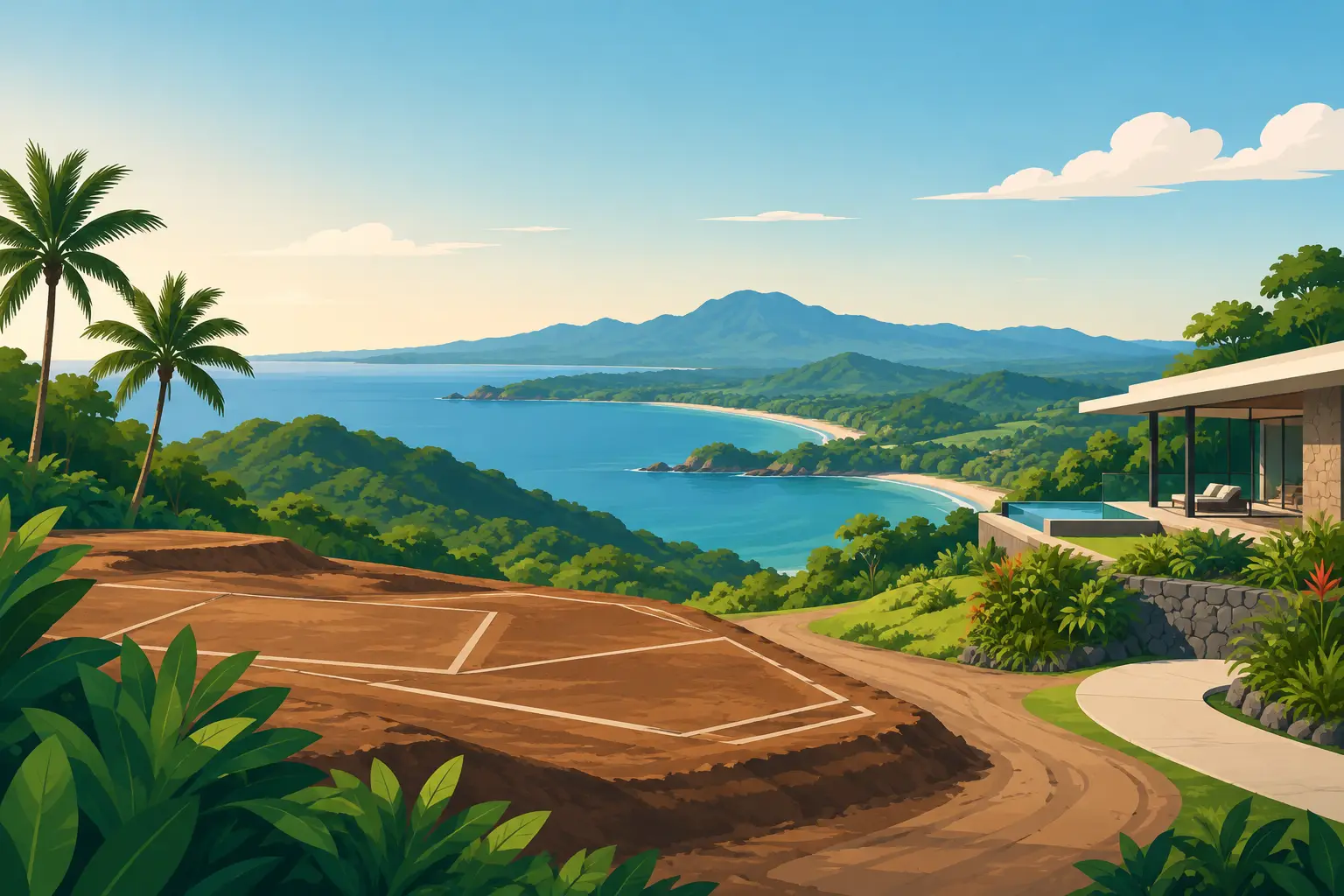
An ocean-view parcel in Costa Rica can look extraordinary at sunset and still be the wrong site for a luxury villa, boutique hotel, or gated residential project. The difference lies below the view line: legal access, water availability, topography, zoning, buildable area, and the cost of turning raw land into a finished asset. This luxury land development guide is designed for buyers who want to make a sophisticated coastal investment decision before committing capital.
For affluent buyers and investors, Costa Rica offers a rare combination of natural beauty, lifestyle appeal, and demand for quality vacation accommodations. In markets such as Manuel Antonio, Quepos, Matapalo, Uvita, Parrita, and the broader Puntarenas coast, the strongest development sites can support both a private luxury retreat and a carefully positioned income strategy. Yet premium land is not interchangeable. A lower-priced parcel may carry infrastructure challenges that erase its apparent value, while a higher-priced site with approved access and utilities can provide a far more efficient path to completion.
Luxury Land Development Guide: Start With the End Use
Before evaluating acreage, establish what the finished property must accomplish. A private estate, a multi-villa vacation rental compound, a small eco-lodge, and a residential subdivision each require a different land profile. The right site for one may be a poor fit for another.
A personal residence may prioritize privacy, sunset exposure, mature forest, and proximity to beaches, restaurants, and medical services. An investor focused on rental income may place greater value on reliable road access, parking, guest circulation, high-speed internet, and a location that can command premium nightly rates. Hospitality buyers must consider operational access for staff, deliveries, waste collection, guest transfers, and emergency services from the earliest stage.
The exit strategy matters as well. Some owners intend to build one signature home and hold it for decades. Others plan to create several titled lots, build a collection of villas, or develop a hospitality asset for resale. Clarifying the intended use early helps determine the appropriate zoning, lot configuration, infrastructure budget, and acquisition structure.
Location Creates the Luxury Premium
Costa Rica's southern Pacific coast offers distinct micro-markets, each with its own development character. Manuel Antonio and Quepos combine established tourism infrastructure with exceptional access to beaches, dining, marina services, and national-park appeal. These areas can command a substantial premium, particularly for properties with protected ocean views and convenient access.
Further south, Matapalo and Uvita appeal to buyers seeking more space, a slower pace, dramatic jungle-to-ocean settings, and an emerging luxury market. Parrita can offer larger land opportunities and strategic access between the Central Pacific and southern coastal destinations. The best choice depends on whether your priority is immediate rental demand, a secluded estate experience, future appreciation potential, or a balance of all three.
Within any market, study the approach to the land rather than judging a property from photographs alone. A panoramic view has real value, but steep roads, seasonal drainage crossings, or a lengthy drive from the main highway can influence construction costs and rental performance. Orientation also deserves attention. West-facing sites may capture celebrated Pacific sunsets, while elevated properties need careful assessment for wind exposure, retaining requirements, and safe vehicle access.
View Corridors Are an Asset to Protect
Not every ocean view is equally durable. Ask what sits between the building envelope and the horizon. Is the foreground privately controlled, protected forest, neighboring land, or an undeveloped parcel that could eventually alter the view? In premium markets, a site with a defensible view corridor can be materially more valuable than one with an impressive but uncertain outlook.
Confirm Legal Access, Title, and Development Rights
Costa Rica offers foreign buyers substantial ownership opportunities, but due diligence must be thorough and locally informed. A qualified Costa Rican real estate attorney should review title history, property boundaries, liens, easements, legal access, municipal records, and the ownership entity before closing. This is not an area for assumptions.
Legal road access is especially critical. A path that has been used for years is not necessarily a properly recorded right of way. Without confirmed access, securing permits, financing construction, moving materials, or reselling the property can become far more complicated. The road itself should also be evaluated for year-round usability, maintenance responsibility, drainage, and suitability for construction vehicles.
Buyers should distinguish between fee-simple titled property and concession land. Much of Costa Rica's maritime zone is subject to different rules, and concession interests require specialized review. A coastal setting can be highly desirable, but the ownership structure and regulatory framework must fit the intended project.
Development rights should be verified rather than inferred from neighboring construction. Confirm permitted uses, density, setbacks, height limitations, environmental requirements, and subdivision potential with the appropriate professionals and authorities. Rules can vary by municipality, location, road classification, and environmental conditions.
Treat Water and Utilities as Core Investment Questions
On luxury land, water is not a minor detail. It is one of the central determinants of whether a project can proceed on schedule and at the desired scale. Buyers should investigate the source of water, available capacity, legal rights or letters of availability, storage needs, and the projected demand of the finished development.
A single villa has different requirements than a five-home compound or a boutique hotel. Pools, landscaping, staff accommodations, laundry operations, and guest usage all affect consumption. A well may be appropriate in certain circumstances, but it requires technical and legal review. Municipal or community water connections can be advantageous where capacity is confirmed, though connection timelines and infrastructure contributions should be understood before purchase.
Electricity, internet, wastewater treatment, and stormwater management deserve the same level of attention. Remote hillside lots may require significant investment in power extensions, backup systems, fiber or satellite connectivity, septic design, and drainage improvements. These costs are not necessarily a reason to avoid a remarkable site. They simply need to be priced accurately, with adequate contingency, before land value is determined.
Buildability Is More Than Parcel Size
A large parcel can have a surprisingly small practical building area. Steep slopes, protected vegetation, creek setbacks, drainage channels, access roads, and required retaining structures can reduce the usable footprint. Topographic and boundary surveys are essential tools for understanding the real opportunity.
For elevated sites, engage an experienced architect and civil engineer early enough to test a conceptual layout. A thoughtful plan may use the terrain to create layered indoor-outdoor living spaces, infinity-edge pools, guest casitas, and framed views. On the other hand, a concept review may reveal that the desired footprint requires excessive earthwork or creates a cost profile that no longer supports the investment thesis.
Build a Development Budget That Reflects Costa Rica
Land price is only the opening number. A disciplined budget should account for closing costs, legal and technical due diligence, design, permits, engineering, site preparation, roads, retaining walls, utility connections, construction, furnishings, landscaping, security, and carrying costs. For hospitality or rental projects, include pre-opening expenses, branding, staffing, operational systems, and a realistic ramp-up period.
Imported finishes, specialized equipment, and remote-site logistics can add expense and lead time. Conversely, Costa Rica offers talented local architects, builders, craftspeople, and materials that can create a distinctive tropical-modern residence without relying exclusively on imported products. The strongest projects balance architectural ambition with practical maintenance in a humid coastal climate.
Contingency is essential, particularly where topography or infrastructure remains uncertain. A buyer who reserves capital for site realities is better positioned to protect quality when conditions change. Cutting drainage, waterproofing, access improvements, or structural work to preserve a cosmetic budget can become costly later.
Design for the Market You Intend to Serve
Luxury buyers and guests are drawn to Costa Rica for open-air living, privacy, nature, and a sense of place. The most compelling developments respect those priorities while delivering the comforts premium clients expect: reliable internet, air-conditioned sleeping areas, generous covered terraces, refined kitchens, secure parking, backup power options, and professional property management.
For a rental-focused project, design decisions should be informed by guest behavior. Multiple primary suites can improve appeal for couples traveling together. Flexible lock-off spaces may allow owners to retain private use while generating revenue. Durable finishes, intuitive circulation, owner storage, and easy service access support long-term operations without compromising the guest experience.
A site should never be forced into a generic model. The architecture, number of units, amenity program, and price point should respond to the property's views, access, neighborhood, and target customer. A secluded Matapalo ridge may reward a low-density estate concept, while a well-located Quepos parcel may support a more active luxury rental strategy.
Assemble the Right Local Team
Land development is a coordinated effort, not a single transaction. Your team may include a real estate specialist, attorney, surveyor, architect, civil engineer, environmental consultant, builder, and property management professionals. Their work should begin before closing whenever possible, so material constraints are identified while the buyer still has negotiating leverage.
Costa Rica Luxury Real Estate helps buyers evaluate premium opportunities across the Pacific coast with an understanding of both lifestyle value and development potential. The most productive conversations begin with a clear brief: preferred region, desired view, target use, budget range, expected timeline, and whether the property must produce income from the outset.
A remarkable parcel deserves more than an emotional offer after a beautiful showing. Bring in qualified local professionals, test the development concept, and let the site prove its potential. When land, legal structure, infrastructure, and design strategy align, a Costa Rica coastal property can become a rare asset: deeply personal, commercially intelligent, and built to hold its appeal for years to come.